 Add to Chrome
 Add to Firefox
 Add to Edge
Dynamic Whole-Body Dancing with Humanoid Robots -- A Model-Based Control Approach
Apr 05, 2026
This paper presents an integrated model-based framework for generating and executing dynamic whole-body dance motions on humanoid robots. The framework operates in two stages: offline motion generation and online motion execution, both leveraging future state prediction to enable robust and dynamic dance motions in real-world environments. In the offline motion generation stage, human dance demonstrations are captured via a motion capture (MoCap) system, retargeted to the robot by solving a Quadratic Programming (QP) problem, and further refined using Trajectory Optimization (TO) to ensure dynamic feasibility. In the online motion execution stage, a centroidal dynamics-based Model Predictive Control (MPC) framework tracks the planned motions in real time and proactively adjusts swing foot placement to adapt to real world disturbances. We validate our framework on the full-size humanoid robot Kuavo 4Pro, demonstrating the dynamic dance motions both in simulation and in a four-minute live public performance with a team of four robots. Experimental results show that longer prediction horizons improve both motion expressiveness in planning and stability in execution.

ECO: Energy-Constrained Optimization with Reinforcement Learning for Humanoid Walking
Feb 06, 2026Achieving stable and energy-efficient locomotion is essential for humanoid robots to operate continuously in real-world applications. Existing MPC and RL approaches often rely on energy-related metrics embedded within a multi-objective optimization framework, which require extensive hyperparameter tuning and often result in suboptimal policies. To address these challenges, we propose ECO (Energy-Constrained Optimization), a constrained RL framework that separates energy-related metrics from rewards, reformulating them as explicit inequality constraints. This method provides a clear and interpretable physical representation of energy costs, enabling more efficient and intuitive hyperparameter tuning for improved energy efficiency. ECO introduces dedicated constraints for energy consumption and reference motion, enforced by the Lagrangian method, to achieve stable, symmetric, and energy-efficient walking for humanoid robots. We evaluated ECO against MPC, standard RL with reward shaping, and four state-of-the-art constrained RL methods. Experiments, including sim-to-sim and sim-to-real transfers on the kid-sized humanoid robot BRUCE, demonstrate that ECO significantly reduces energy consumption compared to baselines while maintaining robust walking performance. These results highlight a substantial advancement in energy-efficient humanoid locomotion. All experimental demonstrations can be found on the project website: https://sites.google.com/view/eco-humanoid.
Integrated Exploration and Sequential Manipulation on Scene Graph with LLM-based Situated Replanning
Feb 04, 2026In partially known environments, robots must combine exploration to gather information with task planning for efficient execution. To address this challenge, we propose EPoG, an Exploration-based sequential manipulation Planning framework on Scene Graphs. EPoG integrates a graph-based global planner with a Large Language Model (LLM)-based situated local planner, continuously updating a belief graph using observations and LLM predictions to represent known and unknown objects. Action sequences are generated by computing graph edit operations between the goal and belief graphs, ordered by temporal dependencies and movement costs. This approach seamlessly combines exploration and sequential manipulation planning. In ablation studies across 46 realistic household scenes and 5 long-horizon daily object transportation tasks, EPoG achieved a success rate of 91.3%, reducing travel distance by 36.1% on average. Furthermore, a physical mobile manipulator successfully executed complex tasks in unknown and dynamic environments, demonstrating EPoG's potential for real-world applications.
Towards Bridging the Gap between Large-Scale Pretraining and Efficient Finetuning for Humanoid Control
Jan 29, 2026Reinforcement learning (RL) is widely used for humanoid control, with on-policy methods such as Proximal Policy Optimization (PPO) enabling robust training via large-scale parallel simulation and, in some cases, zero-shot deployment to real robots. However, the low sample efficiency of on-policy algorithms limits safe adaptation to new environments. Although off-policy RL and model-based RL have shown improved sample efficiency, the gap between large-scale pretraining and efficient finetuning on humanoids still exists. In this paper, we find that off-policy Soft Actor-Critic (SAC), with large-batch update and a high Update-To-Data (UTD) ratio, reliably supports large-scale pretraining of humanoid locomotion policies, achieving zero-shot deployment on real robots. For adaptation, we demonstrate that these SAC-pretrained policies can be finetuned in new environments and out-of-distribution tasks using model-based methods. Data collection in the new environment executes a deterministic policy while stochastic exploration is instead confined to a physics-informed world model. This separation mitigates the risks of random exploration during adaptation while preserving exploratory coverage for improvement. Overall, the approach couples the wall-clock efficiency of large-scale simulation during pretraining with the sample efficiency of model-based learning during fine-tuning.
ReSPIRe: Informative and Reusable Belief Tree Search for Robot Probabilistic Search and Tracking in Unknown Environments
Dec 31, 2025Target search and tracking (SAT) is a fundamental problem for various robotic applications such as search and rescue and environmental exploration. This paper proposes an informative trajectory planning approach, namely ReSPIRe, for SAT in unknown cluttered environments under considerably inaccurate prior target information and limited sensing field of view. We first develop a novel sigma point-based approximation approach to fast and accurately estimate mutual information reward under non-Gaussian belief distributions, utilizing informative sampling in state and observation spaces to mitigate the computational intractability of integral calculation. To tackle significant uncertainty associated with inadequate prior target information, we propose the hierarchical particle structure in ReSPIRe, which not only extracts critical particles for global route guidance, but also adjusts the particle number adaptively for planning efficiency. Building upon the hierarchical structure, we develop the reusable belief tree search approach to build a policy tree for online trajectory planning under uncertainty, which reuses rollout evaluation to improve planning efficiency. Extensive simulations and real-world experiments demonstrate that ReSPIRe outperforms representative benchmark methods with smaller MI approximation error, higher search efficiency, and more stable tracking performance, while maintaining outstanding computational efficiency.
In-situ Value-aligned Human-Robot Interactions with Physical Constraints
Aug 11, 2025Equipped with Large Language Models (LLMs), human-centered robots are now capable of performing a wide range of tasks that were previously deemed challenging or unattainable. However, merely completing tasks is insufficient for cognitive robots, who should learn and apply human preferences to future scenarios. In this work, we propose a framework that combines human preferences with physical constraints, requiring robots to complete tasks while considering both. Firstly, we developed a benchmark of everyday household activities, which are often evaluated based on specific preferences. We then introduced In-Context Learning from Human Feedback (ICLHF), where human feedback comes from direct instructions and adjustments made intentionally or unintentionally in daily life. Extensive sets of experiments, testing the ICLHF to generate task plans and balance physical constraints with preferences, have demonstrated the efficiency of our approach.
Embedding high-resolution touch across robotic hands enables adaptive human-like grasping
Dec 19, 2024


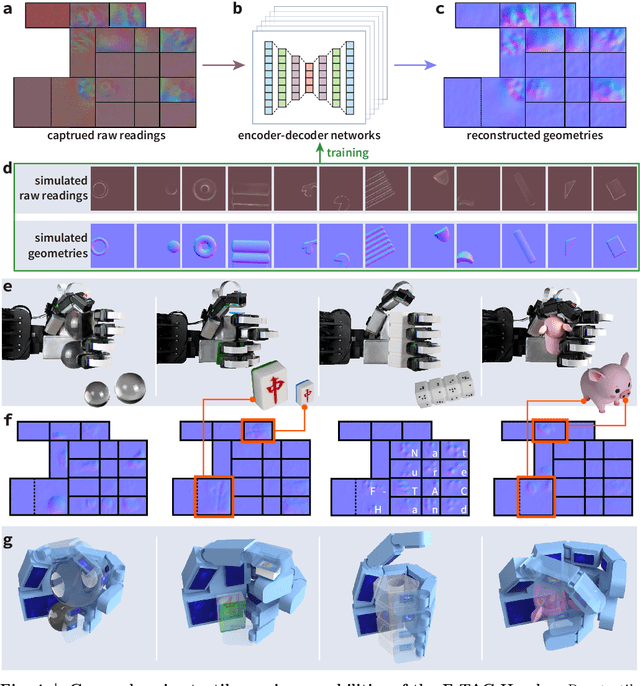
Developing robotic hands that adapt to real-world dynamics remains a fundamental challenge in robotics and machine intelligence. Despite significant advances in replicating human hand kinematics and control algorithms, robotic systems still struggle to match human capabilities in dynamic environments, primarily due to inadequate tactile feedback. To bridge this gap, we present F-TAC Hand, a biomimetic hand featuring high-resolution tactile sensing (0.1mm spatial resolution) across 70% of its surface area. Through optimized hand design, we overcome traditional challenges in integrating high-resolution tactile sensors while preserving the full range of motion. The hand, powered by our generative algorithm that synthesizes human-like hand configurations, demonstrates robust grasping capabilities in dynamic real-world conditions. Extensive evaluation across 600 real-world trials demonstrates that this tactile-embodied system significantly outperforms non-tactile alternatives in complex manipulation tasks (p<0.0001). These results provide empirical evidence for the critical role of rich tactile embodiment in developing advanced robotic intelligence, offering new perspectives on the relationship between physical sensing capabilities and intelligent behavior.
MiniTac: An Ultra-Compact 8 mm Vision-Based Tactile Sensor for Enhanced Palpation in Robot-Assisted Minimally Invasive Surgery
Oct 30, 2024Robot-assisted minimally invasive surgery (RAMIS) provides substantial benefits over traditional open and laparoscopic methods. However, a significant limitation of RAMIS is the surgeon's inability to palpate tissues, a crucial technique for examining tissue properties and detecting abnormalities, restricting the widespread adoption of RAMIS. To overcome this obstacle, we introduce MiniTac, a novel vision-based tactile sensor with an ultra-compact cross-sectional diameter of 8 mm, designed for seamless integration into mainstream RAMIS devices, particularly the Da Vinci surgical systems. MiniTac features a novel mechanoresponsive photonic elastomer membrane that changes color distribution under varying contact pressures. This color change is captured by an embedded miniature camera, allowing MiniTac to detect tumors both on the tissue surface and in deeper layers typically obscured from endoscopic view. MiniTac's efficacy has been rigorously tested on both phantoms and ex-vivo tissues. By leveraging advanced mechanoresponsive photonic materials, MiniTac represents a significant advancement in integrating tactile sensing into RAMIS, potentially expanding its applicability to a wider array of clinical scenarios that currently rely on traditional surgical approaches.
M2Diffuser: Diffusion-based Trajectory Optimization for Mobile Manipulation in 3D Scenes
Oct 15, 2024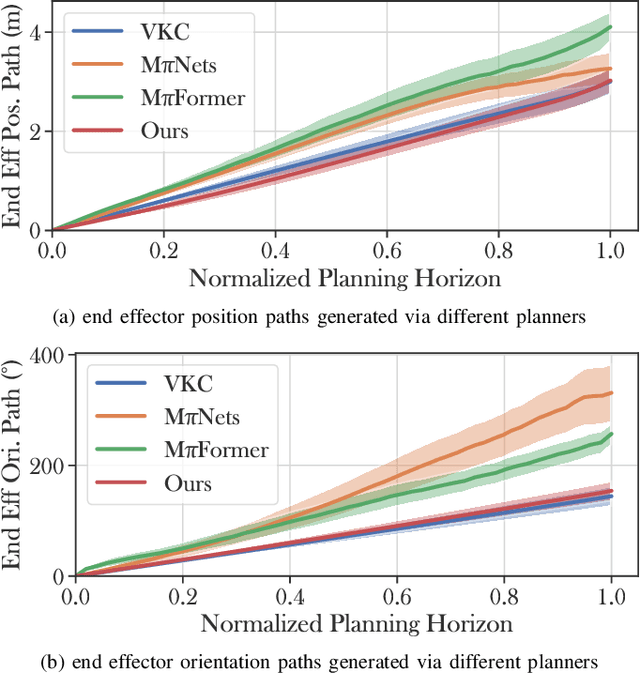
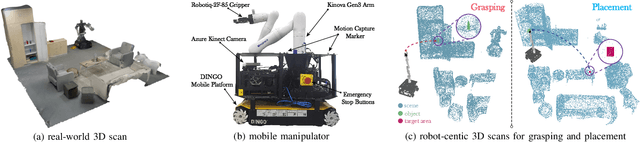
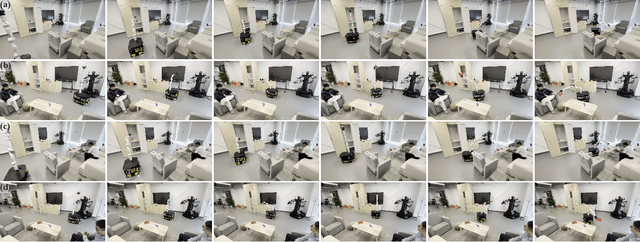
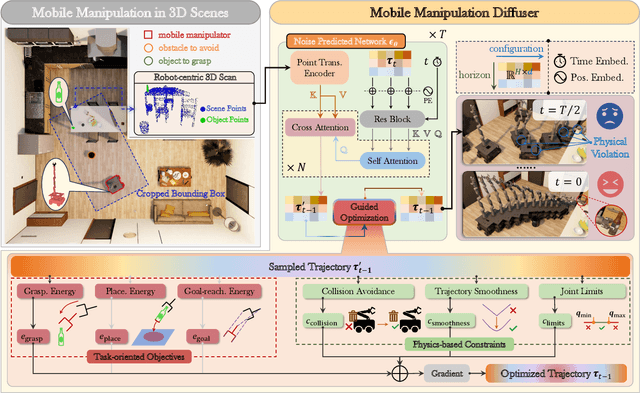
Recent advances in diffusion models have opened new avenues for research into embodied AI agents and robotics. Despite significant achievements in complex robotic locomotion and skills, mobile manipulation-a capability that requires the coordination of navigation and manipulation-remains a challenge for generative AI techniques. This is primarily due to the high-dimensional action space, extended motion trajectories, and interactions with the surrounding environment. In this paper, we introduce M2Diffuser, a diffusion-based, scene-conditioned generative model that directly generates coordinated and efficient whole-body motion trajectories for mobile manipulation based on robot-centric 3D scans. M2Diffuser first learns trajectory-level distributions from mobile manipulation trajectories provided by an expert planner. Crucially, it incorporates an optimization module that can flexibly accommodate physical constraints and task objectives, modeled as cost and energy functions, during the inference process. This enables the reduction of physical violations and execution errors at each denoising step in a fully differentiable manner. Through benchmarking on three types of mobile manipulation tasks across over 20 scenes, we demonstrate that M2Diffuser outperforms state-of-the-art neural planners and successfully transfers the generated trajectories to a real-world robot. Our evaluations underscore the potential of generative AI to enhance the generalization of traditional planning and learning-based robotic methods, while also highlighting the critical role of enforcing physical constraints for safe and robust execution.
M3Bench: Benchmarking Whole-body Motion Generation for Mobile Manipulation in 3D Scenes
Oct 15, 2024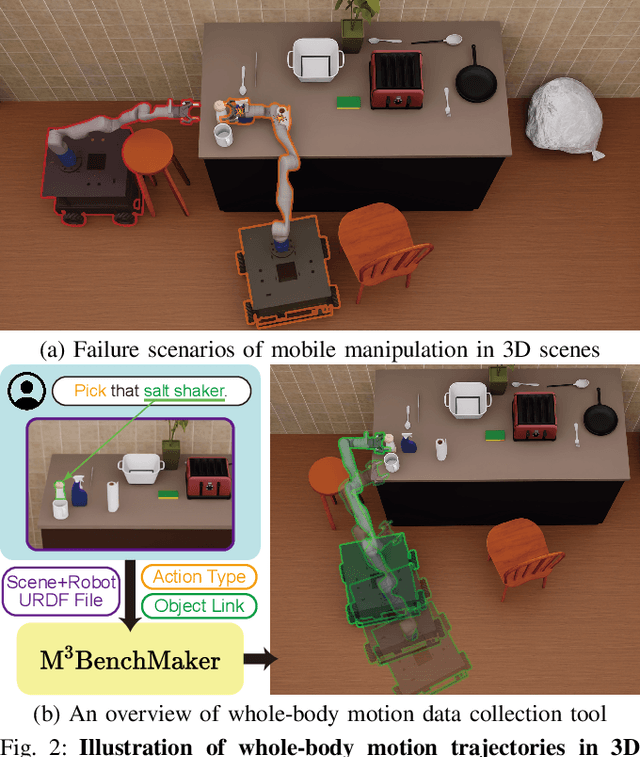
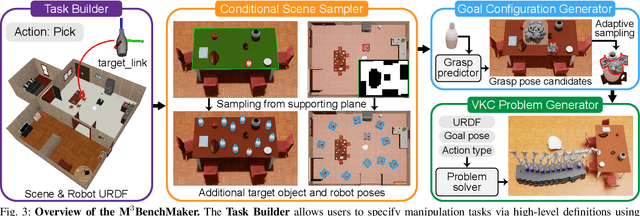
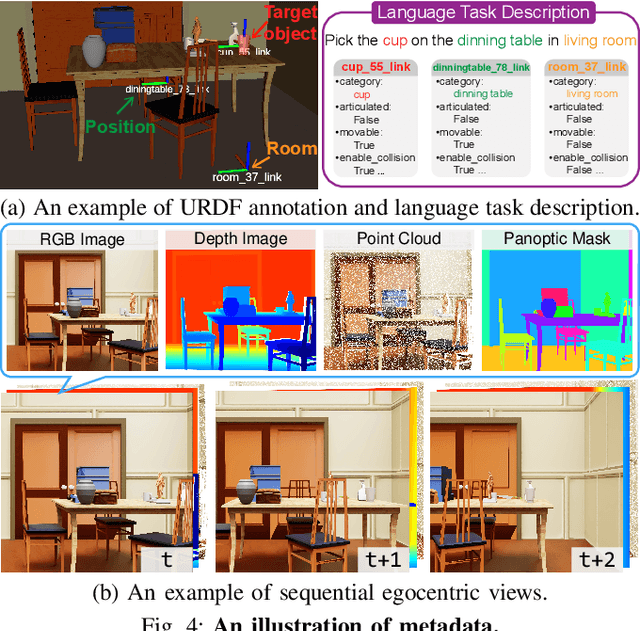
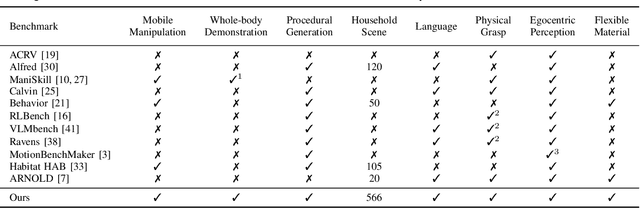
We propose M^3Bench, a new benchmark of whole-body motion generation for mobile manipulation tasks. Given a 3D scene context, M^3Bench requires an embodied agent to understand its configuration, environmental constraints and task objectives, then generate coordinated whole-body motion trajectories for object rearrangement tasks. M^3Bench features 30k object rearrangement tasks across 119 diverse scenes, providing expert demonstrations generated by our newly developed M^3BenchMaker. This automatic data generation tool produces coordinated whole-body motion trajectories from high-level task instructions, requiring only basic scene and robot information. Our benchmark incorporates various task splits to assess generalization across different dimensions and leverages realistic physics simulation for trajectory evaluation. Through extensive experimental analyses, we reveal that state-of-the-art models still struggle with coordinated base-arm motion while adhering to environment-context and task-specific constraints, highlighting the need to develop new models that address this gap. Through M^3Bench, we aim to facilitate future robotics research towards more adaptive and capable mobile manipulation in diverse, real-world environments.